Bangladesh Road Accidents Are Finally Dropping in 2026. But the Roads Are Still Killing Hundreds Every Month
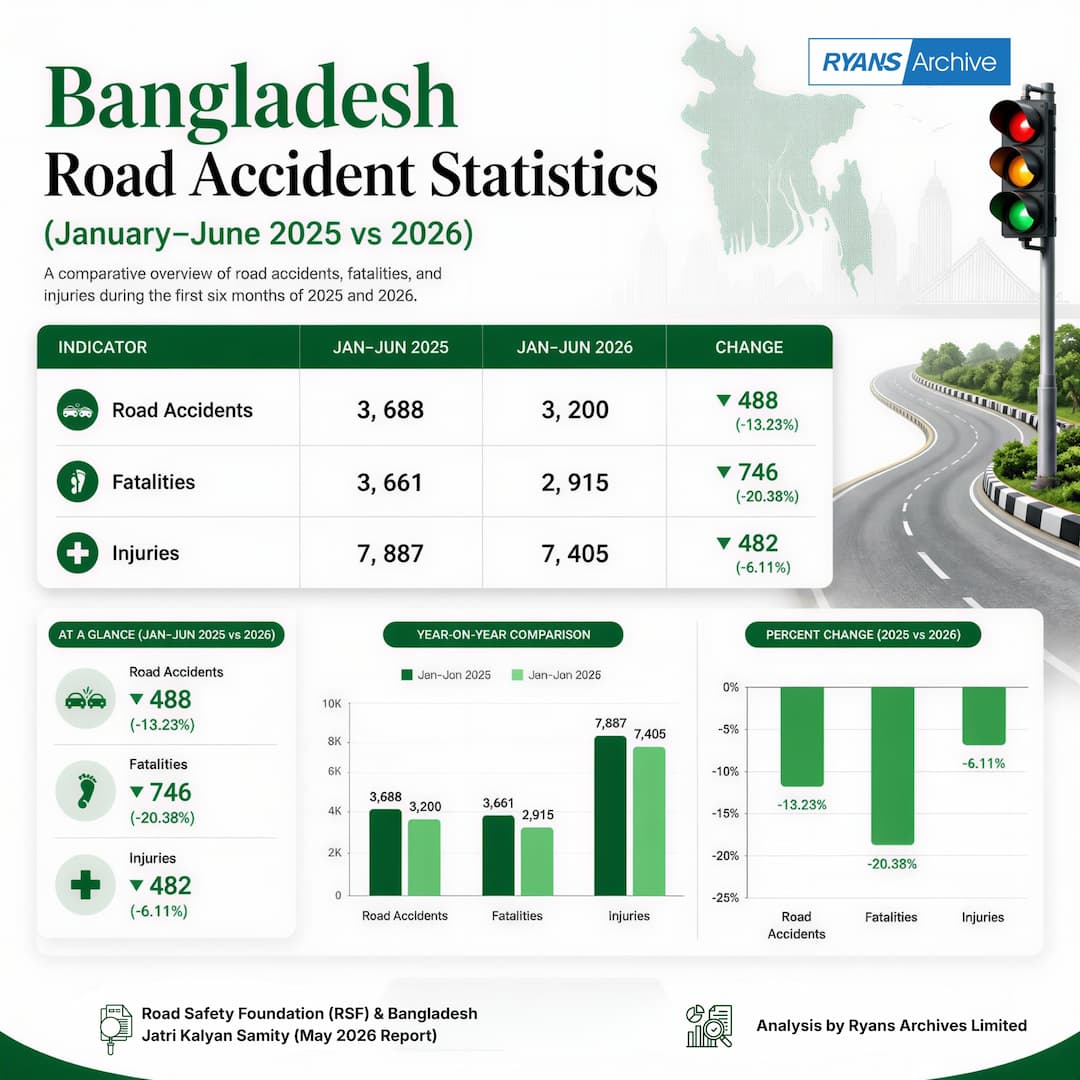
A month-by-month look at how road accidents, deaths, and injuries changed between January–June 2025 and January–June 2026 - and why motorcycles and pedestrian crossings remain the biggest danger zones.
Data compiled from Road Safety Foundation (RSF) and Bangladesh Jatri Kalyan Samity monthly reports
Ask any rickshaw puller, bus driver, or daily commuter in Bangladesh, and they'll tell you the same thing: the roads feel a little less deadly this year. And the numbers back them up.
Fresh data comparing January–June 2025 with January–June 2026 shows a real, measurable drop in road accidents, deaths, and injuries across the country. It's genuinely good news. But before anyone starts celebrating, the same data tells a harder truth - motorcycles, pedestrian crossings, and holiday travel are still turning Bangladesh's highways into a national crisis.
Here's what the numbers actually say, and why they matter to anyone who steps onto a Bangladeshi road.
The Big Picture: What Changed Between 2025 and 2026
Comparing the first six months of both years, three things stand out immediately.
Road Accidents 3,200▼ 488 (-13.2%)
Fatalities 2,915▼ 746 (-20.4%)
Injuries 7,405▼ 482 (-6.1%)
That gap between the fatality drop (20%) and the injury drop (6%) is worth sitting with. It suggests something more than just "fewer cars on the road." It hints that when crashes do happen now, fewer of them are ending in death - possibly a sign that emergency response, road design, or vehicle safety features are slowly improving, even if crash frequency isn't falling as fast as anyone would like.
Still, do the math on what's left: even after this improvement, Bangladesh lost close to 3,000 people to road crashes in just six months. That's roughly 16 deaths a day, every single day, from January through June 2026.
Month by Month: Where the Numbers Tell a Story
Break the 2026 data down by month and a pattern jumps out. January, February, and April were relatively calm - fatalities stayed in the 400s. March saw injuries spike to 2,221, the highest of any month in either year, even though the death toll that month wasn't the worst. That mismatch usually points to a few mass-casualty crashes - buses or trucks involved in pile-ups - rather than a steady rise in everyday accidents.
Then comes May. Deaths jumped to 622, and accidents climbed to 613 - the worst month of 2026 by a wide margin. This lines up almost exactly with what road safety officials have said for years: Eid-ul-Adha travel is one of the deadliest periods on Bangladesh's roads. Millions of people rushing home at once, overloaded buses, exhausted drivers, and highways that simply weren't built for that kind of traffic surge - it's a recipe that repeats every year around the holiday.
June, interestingly, dropped back down to 438 deaths, suggesting the post-Eid traffic eased off and roads returned to a more normal rhythm.
"In 2025, June was the deadliest month of the year, with 696 deaths. In 2026, June came in far lower at 438 - a sign the holiday-season spike is shrinking, even if it hasn't disappeared."
Motorcycles Are Still the Number One Killer
If there's one single fact that should shape road safety policy in Bangladesh right now, it's this: motorcycle crashes remain the leading cause of road deaths, year after year.
In 2025, motorcycle accidents claimed 1,379 lives. In 2026, that number dropped to 934 - still a massive share, accounting for somewhere between 30% and 44% of all road deaths depending on the month.
Motorcycles are cheap, fast, and perfect for navigating Dhaka's brutal traffic - which is exactly why so many young men and delivery riders depend on them daily. But that same speed and lack of protection is what makes them so lethal. A car crash often means injuries. A motorcycle crash, especially at highway speed or in mixed traffic, far too often means a funeral.
Any serious push to bring these numbers down further has to start here - stricter helmet enforcement, better rider training, and real consequences for reckless overtaking on two wheels.
Pedestrians Keep Paying the Price
The second recurring theme in this data is pedestrians. Roughly 100 people on foot were killed every single month in both 2025 and 2026 - full stop, month after month, with barely any variation.
That consistency is almost more disturbing than a spike would be. It means there's no "bad month" for pedestrians in Bangladesh - every month is a bad month. Poor footpaths, missing crosswalks, and drivers who simply don't slow down near markets, schools, or bus stops all play a part. Until footpath infrastructure and pedestrian crossings get real investment, this number isn't likely to move much on its own.
Women and Children Are Still Losing Their Lives in Large Numbers
The report also breaks down victims by gender and age, and the figures deserve attention. In 2025, 489 women and 536 children died in road crashes. In 2026, those numbers dropped to 287 and 321 respectively - a meaningful improvement, but still hundreds of preventable deaths involving some of the most vulnerable people on the road.
Drivers and transport assistants - the people literally running the country's transport system - also continue to die in large numbers, with 495 lives lost in 2025 and 300 in 2026.
Why the Numbers Are Improving And Why That's Not the Whole Story
It's tempting to credit better enforcement or safer vehicles for this year's drop, and those factors probably do play a role. But road safety experts in Bangladesh have pointed to several forces working together: stronger awareness campaigns after a string of high-profile crashes, tighter police checkpoints during holiday travel, and gradual improvements to some highway sections.
At the same time, no single reform explains a 20% fatality drop. It's more likely a combination of smaller wins - slightly better enforcement here, a safer stretch of highway there, more people wearing helmets than before - adding up over six months.
The risk now is complacency. A 20% drop sounds impressive on paper, but Bangladesh is still one of the more dangerous countries in the region for road travel. One bad Eid season, one relaxed enforcement period, and these gains could evaporate fast.
What Actually Needs to Happen Next
Based on what this data shows, a few priorities stand out clearly. Motorcycle safety needs the most urgent attention, since it's still the single biggest killer on Bangladeshi roads by a wide margin. Pedestrian infrastructure - proper footpaths, marked crossings, speed-calming near busy areas - needs real investment, not just awareness posters.
Holiday travel management around Eid and other major festivals needs to be treated as its own emergency period every year, with extra highway patrols, bus inspections, and public transport planning well before the rush begins. And driver training and licensing standards need tightening, especially for long-haul bus and truck drivers who are frequently linked to the deadliest mass-casualty crashes.
The Bottom Line
Bangladesh's roads got safer in the first half of 2026 compared to 2025 - that much is undeniable, and it's worth recognizing as real progress. Fewer accidents, fewer injuries, and hundreds of families spared from tragedy.
But "safer" is a relative word here. Nearly 3,000 people still died in six months. Motorcycles are still killing riders at an alarming rate. Pedestrians are still dying at a steady, unbroken pace every single month. And Eid travel is still, predictably, the deadliest stretch of the year.
The trend line is finally pointing in the right direction. The job now is making sure it stays that way - and speeds up.
Data sources: Road Safety Foundation (RSF) monthly reports for January–June 2025 and January, February, March, April, and June 2026; Bangladesh Jatri Kalyan Samity monthly report for May 2026.